On (not) Proving the Point
And that's true, too

I will be among the first to say that literature isn’t for anything, any more than a piece of music or a painting exists to prove or support something. In “Post-Literate Age,” some months back in the Atlantic, George Packer touched on a few of the things I hold to in my own work and reading.
For instance, writing about his new novel, The Emergency, Packer says, “I wanted to get as far as possible from these exhausted particulars in order to explore their deeper reality. I wanted to evoke the feeling of being alive right now...And I wanted to see every side of this drama.”
Which sounds great and has the makings of something interesting and compelling. “The Emergency is a political novel,” he continued, “but I wrote it as a fable..” in order to get outside his journalist’s head.
But his discussion of writing prose, and his juxtaposition of what journalism does and what fiction does sounds like two sides of the same coin—and too much like making a point, providing an answer or a moral. Just in a different way.
In fiction, to paraphrase Anton Chekhov, “the task of the writer is not to solve the problem, but to state the problem correctly.” And the problem is a question that readers resolve for themselves. James Baldwin said something similar when he noted that the writer’s task is to “drive to the heart of every answer and expose the question the answer hides.”
Is it true that “Happy families are all alike; but every unhappy family is unhappy in its own way,” as Tolstoy asserts at the beginning of Anna Karenina? We may decide for ourselves.
Is George Eliot correct, in one of my favorite novels, Middlemarch, that perhaps “things are not so ill with you and me as they might have been…owing to the number who lived faithfully a hidden life, and rest in unvisited tombs.”
If you doubt this proposition, ask yourself about the books or movies or paintings you have returned to at different points in your life. You “see” and “understand” them differently. You take away different impressions and ideas at each rereading. (One hopes!) The work has not changed, but you have.
And so have your thoughts on the questions it poses.
As I wrote elsewhere, I was pleased that George Saunders, a writer whose work I admire, gave the Chekhov quote above when discussing his new novel, Vigil. I have not read the book, but in some of the reviews I have read, it sounds as if Saunders took the idea of questions a little too literally. If not literarily.
Two angels bicker and pose questions for the reader as to whether the dying man at the center of the story, an oil tycoon and avowed planet destroyer, deserves mercy. I will reserve judgement until I’ve actually read Vigil, but it sounds as if much of the narrative force of the book is represented by questions.
Which is not what the idea of questions is about. The examples above, about “unhappy families” and “unvisited graves,” are statements, which the reader must question and decide about for themselves.
Fiction should not be didactic. It is a story, and it will succeed or fail with each individual reader as a story. But it also (one hopes) enlarges the scope of that reader’s imagination by positing moments, ideas or conclusions that don’t necessarily conform to nice, neat factual boxes, what Werner Herzog calls “accountant’s truth.”
Moreover, there should be ambiguity, contingency.
One of my favorite Shakespeare quotes comes from King Lear (V,ii): Edgar notes that “Men must endure their going hence, even as their coming hither; Ripeness is all.” To which the Earl of Gloucester responds, “And that’s true too.”
In the film version of The Torch Song Trilogy, Arnold and Ma Beckhoff have one of their many bitter arguments. Arnold lays into his mother, and as I watched, I found myself saying “Yeah, Arnie, you tell her!” only to find myself listening to her side and thinking, “And that’s true, too.”
Good fiction doesn’t ask you what the author thinks, but rather, in an uncertain world, what do you think, how do you feel, and why? That questioning is its superpower.
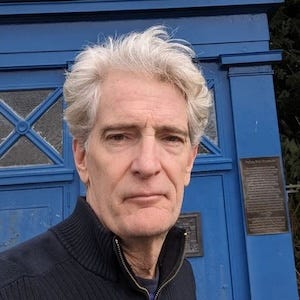
James McCrone’s stories raise questions about the nature of power, the choices we make and the lessons we don’t learn.
He’s the author of the Imogen Trager political suspense-thrillers Faithless Elector, Dark Network and Emergency Powers–noir tales about a stolen presidency, a conspiracy, and a nation on edge. Bastard Verdict, his fourth novel, is about a conspiracy surrounding a second Scottish Independence referendum. His current novel, Witness Tree, is out on submission.
All books are available on BookShop.org, IndyBound.org, Barnes & Noble, your local bookshop, and Amazon. eBooks are available in multiple formats including Apple, Kobo, Nook and Kindle.
James is a member of Mystery Writers of America, Int’l Assoc. of Crime Writers, and he’s the current president of the Delaware Valley chapter of Sisters in Crime. He has an MFA from the University of Washington in Seattle, and he now lives and writes in Philadelphia, PA.
For a full list of appearances and readings, make sure to check out his Events/About page. And follow him on here, or on Substack!
It's a tough topic, and the breadth of fiction is so wide that it's impossible for a single aesthetic to apply to everything - even just good writing, leaving out the tons of dreck. I like Conrad's words on striving for truth, for lack of a better word, in depiction: “There is not a place of splendour or a dark corner of the earth that does not deserve, if only a passing glance of wonder and pity. The task . . . is to hold up unquestioningly the rescued fragment . . . to show its vibration its colour, its form . . . to disclose its inspiring secret: the stress and passion within the core of each convincing moment."