Questions, not answers

You are reading James McCrone’s Substack newsletter, essays and thoughts on literature (mostly crime thrillers), book reviews, and some of my original fiction. Thank you for subscribing!
I was gratified to learn that author George Saunders and I are both taken with Chekhov’s notion of literature as posing a question(s) rather than supplying answers. In an interview with David Marchese in the New York Times Magazine, Saunders notes, “There’s this Chekhov quote that I’m kind of living by lately. He says a work of art doesn’t have to solve a problem — it just has to formulate it correctly.”
I’m excited that a writer whose work I admire is guided by similar principles. In a blogpost last year, I discussed the same quote as it related to my own work, from Maria Popova’s newsletter The Marginalian. In Popova’s August 2021 newsletter “How (Not) to Be a Writer” she quotes Anton Chekhov: “The task of the writer is not to solve the problem, but to state the problem correctly.”
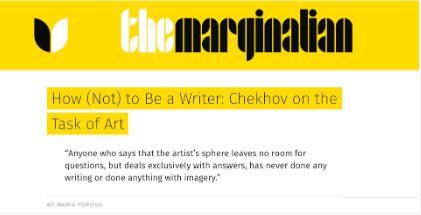
Chekhov goes on to say: “Anyone who says that the artist’s sphere leaves no room for questions, but deals exclusively with answers, has never done any writing or done anything with imagery. The artist observes, selects, guesses, and arranges; every one of these operations presupposes a question at its outset. If he has not asked himself a question at the start, he has nothing to guess and nothing to select.” James Baldwin said something similar when he noted that the writer’s task is to “drive to the heart of every answer and expose the question the answer hides.”
The reader supplies the answers.
You can ask yourself whether this is true by considering your reactions to those personally favorite or influential books which you have re-read at different points in your life. Sometimes, a book you read at, say, 17 years old seems to be about something entirely different when you read it again at 30. The text hasn’t changed, but you have. (One hopes!) And so have your answers to the questions posed in the story.
Is it true that “Happy families are all alike; but every unhappy family is unhappy in its own way,” as Tolstoy asserts at the beginning of Anna Karenina? Is it true “that things are not so ill with you and me as they might have been…owing to the number who lived faithfully a hidden life, and rest in unvisited tombs?” as George Eliot asks in Middlemarch? What do you make of the character of “Control” in Le Carre’s The Spy Who Came in from the Cold, when he asserts: “Our methods—ours and those of the opposition—have become much the same. I mean you can’t be less ruthless than the opposition simply because your government’s ‘policy’ is benevolent, can you now?”
In The Unbearable Lightness of Being, Milan Kundera notes that in the kitsch of totalitarianism, “there are no questions; all answers are given in advance.”

James McCrone’s stories pose questions about the nature of power, the choices we make and the lessons we don’t learn.
He’s the author of the Imogen Trager political suspense-thrillers Faithless Elector, Dark Network , and Emergency Powers–noir tales about a stolen presidency, a conspiracy, and a nation on edge. Bastard Verdict, his fourth novel, is about a conspiracy surrounding a second Scottish Independence referendum. His current novel, Witness Tree, is out on submission.
All books are available on BookShop.org, IndyBound.org, Barnes & Noble, your local bookshop, and Amazon.
eBooks are available in multiple formats including Apple, Kobo, Nook and Kindle.
James is a member of Mystery Writers of America, Int’l Assoc. of Crime Writers, and he’s the current president of the Delaware Valley chapter of Sisters in Crime. He has an MFA from the University of Washington in Seattle, and he now lives and writes in Philadelphia, PA.
For a full list of appearances and readings, make sure to check out his Events/About page. And follow this Substack!