Screen Memory and Backstory
Infantilizing backstory in novels and dramas

In literature and in life, there is a profound difference between a painful, transformative life episode, and the wandering, pages-long therapy dumps I’ve encountered in what might otherwise have been a good story.
I would like to look at whether it’s deeper, or if this is owing to what I call the “Netflix effect,” wherein a televised story that should have been three episodes gets padded to six.
In an interview I came across recently, the writer and comedian, Stephen Merchant discussed his favorite “backstory” dialogue, from the Clint Eastwood film, Escape from Alcatraz. A fellow prisoner asks Eastwoods’ character, “When’s your birthday?”
“I don’t know,” says Eastwood.
“Jeez,” the other prisoner responds, “what kind of childhood did you have?”
“Short,” says Eastwood.
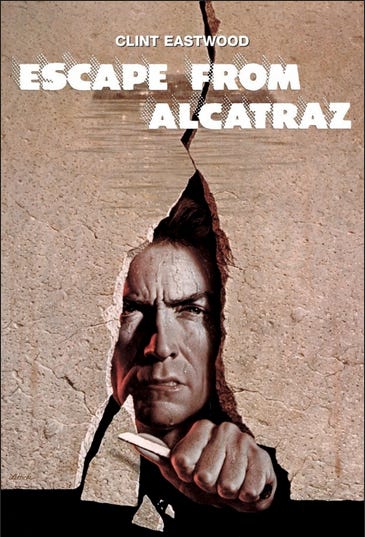
Merchant’s point, and I agree, is that to understand the character, we don’t need to know that Eastwood’s character was born to an unwed, drug addict mother who…etc., etc.
A man who doesn’t know his own birthday and describes his childhood only as “short?” We supply our own sad horrors, and they will be more real than something supplied for us.
The writer’s question should be, Does it help the story?
Besides weighing down the story, detailed or involved backstories sound too much like reasons, like tidy bows. Definitive. Didactic. Done poorly, it shrinks the world of the character and strongly suggests that history is destiny. (In the story, it may indeed be, but that should be for the reader to decide.)
Too often, they read like “screen memories,” which the American Psychological Association defines as “a memory of a childhood experience, usually trivial in nature, that unconsciously serves the purpose of concealing or screening out, or is a conflation of, an associated experience of a more significant and perhaps traumatic nature.”
Just as witness testimony can be subject to unconscious revision, distorted, and/or wrong, screen memories are prim narratives we tell ourselves in order to protect ourselves from something bigger or worse or more traumatic.
The rage for backstory in novels and dramas to explain why a character is the way they are infantilizes the character, the story, and the reader because it gives reasons, it supplies an answer.
It’s usually much more complicated than that. And richer.
The writer, like an actor, should know a great deal about their character(s)’ past in order to bring the character fully to life. Writers of historical dramas will tell you that they have to winnow their research to just those parts that are necessary to tell the story.
In my own work in the Faithless Elector trilogy, there were volumes of arcane political rules, procedures, norms and laws—many of them fascinating. I created histories for the main characters. But little of it made it into the prose because it didn’t serve the story.
Which is meant to open a world, not delimit it.

James McCrone’s stories raise questions about the nature of power, the choices we make and the lessons we don’t learn.
He’s the author of the Imogen Trager political suspense-thrillers Faithless Elector, Dark Network and Emergency Powers–noir tales about a stolen presidency, a conspiracy, and a nation on edge. Bastard Verdict, his fourth novel, is about a conspiracy surrounding a second Scottish Independence referendum. His current novel, Witness Tree, is out on submission.
All books are available on BookShop.org, IndyBound.org, Barnes & Noble, your local bookshop, and Amazon. eBooks are available in multiple formats including Apple, Kobo, Nook and Kindle.
James is a member of Mystery Writers of America, Int’l Assoc. of Crime Writers, and he’s the current president of the Delaware Valley chapter of Sisters in Crime. He has an MFA from the University of Washington in Seattle, and he now lives and writes in Philadelphia, PA.
For a full list of appearances and readings, make sure to check out his Events/About page. And follow him on here, or on Substack!
I love the “Escape from Alcatraz” story, and I agree that as a reader, I don’t need to be spoon fed a character’s history—I enjoy filling in some of that myself. Great post!